
The AL profile 40x40 is one of the most widely used structural components in factory automation. Its square cross-section, lightweight build, and T-slot design make it suitable for building machine frames, conveyor frames, and industrial workstations. Engineers rely on it because it combines structural rigidity with modular flexibility — allowing fast assembly, reconfiguration, and expansion without welding or heavy fabrication.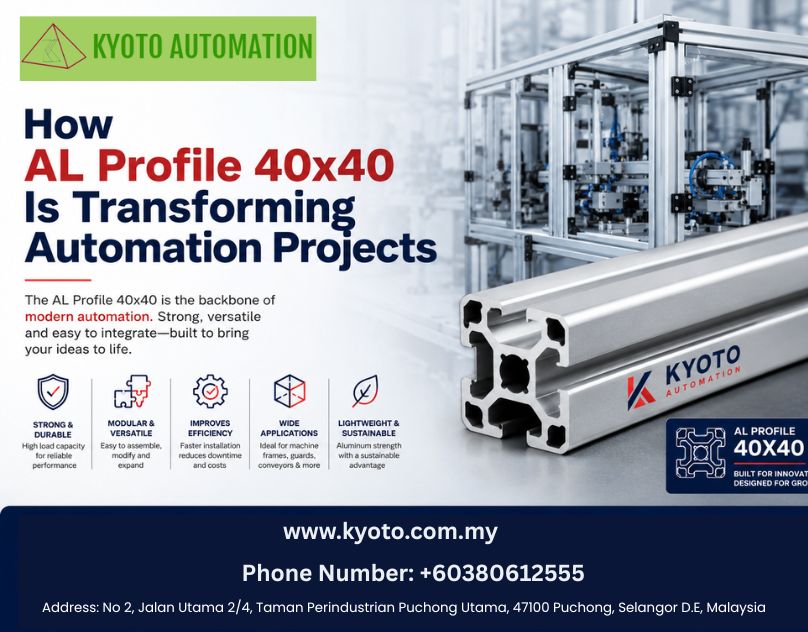
Why AL Profile 40x40 Is the Default Choice for Automation Engineers
Walk into any modern manufacturing facility in Malaysia, and you will likely find 40x40 aluminium profiles holding something together. Whether it is a robotic arm enclosure, a parts inspection station, or a custom conveyor guide rail — this profile size has become the structural backbone of light-to-medium duty automation.
The appeal is straightforward. A 40x40 profile weighs significantly less than equivalent mild steel sections, yet it offers enough load-bearing capacity for most automation sub-assemblies. The T-slot groove system built into all four faces means components can be attached at any point along the length without pre-drilling. That alone cuts build time dramatically on the production floor.
In Malaysia's growing automation sector — driven by Industry 4.0 adoption across electronics, food and beverage, and automotive supply chain industries — flexibility and speed of deployment are critical. The 40x40 profile delivers both.
Machine Frames: The Foundation of Automated Equipment
When engineers design custom automated machines, the structural frame is the first decision. Machine frames built with AL profile 40x40 are popular across industries because they can be cut, assembled, and modified on-site without specialist fabrication equipment.
What Makes 40x40 Profiles Ideal for Machine Frames?
The 40x40 cross-section provides a solid balance between stiffness and weight. For machines that handle light components — such as PCB assembly equipment, packaging machinery, or pneumatic pick-and-place units — the profile handles static and dynamic loads reliably without the mass penalty of steel.
Modular design: Frames can be extended or reconfigured as production requirements change.
Corrosion resistance: Anodised aluminium holds up well in humid factory environments common in Malaysia.
Vibration damping: Aluminium naturally absorbs vibration better than steel, which matters for precision machinery.
Clean room compatibility: No rust, no flaking — suitable for electronics and pharmaceutical assembly environments.
A typical automated vision inspection machine, for instance, uses a 40x40 frame to mount cameras, lighting rigs, and conveyor guides in a single rigid but adjustable structure. Engineers can reposition sensors simply by sliding brackets along the T-slot groove — no downtime, no re-drilling.
Conveyor Frames: Building Flexible Transport Systems
Conveyor systems are the circulatory system of any production line. Conveyor frames built with AL profile 40x40 offer a level of adaptability that welded steel frames simply cannot match once installed.
How Is AL Profile 40x40 Used in Conveyor Construction?
The standard 40x40 profile is used to form the side rails, cross-members, and leg supports of belt and roller conveyors. Because the T-slot accepts standard connector hardware, conveyor lines can be lengthened, curved, or elevated without major structural rework.
In Malaysia's electronics manufacturing hubs — particularly in Penang, Selangor, and Johor — automated assembly lines frequently use modular aluminium conveyor frames to move PCBs, semiconductor components, and finished goods between workstations. The ability to quickly reconfigure these lines during product changeovers is a direct competitive advantage.
Key conveyor applications for the 40x40 profile include:
Flat belt conveyor side rails for light assembly lines
Roller conveyor frames for carton and tray handling
Overhead conveyor guide structures
Incline conveyor leg and support frames
Sensor and stop-gate mounting along conveyor runs
Industrial Workstations: Ergonomic and Reconfigurable
Beyond machines and conveyors, industrial workstations are one of the most practical applications for the 40x40 aluminium profile. In lean manufacturing environments, workstations need to evolve as processes improve. Aluminium profile systems make that evolution fast and cost-effective.
What Are the Advantages of Aluminium Profile Workstations?
Workstations built with 40x40 profiles are height-adjustable, modular, and can incorporate shelving, monitor arms, tool holders, and cable management directly into the frame structure. This is particularly valuable in mixed-model assembly environments where different products require different tooling layouts.
For automation engineers rolling out new production cells, the ability to assemble a fully functional workstation in hours — rather than waiting days for a fabricated steel structure — has a direct impact on project timelines and costs.
Safety Enclosures and Guarding Structures
Machine safety is non-negotiable on any production floor. The AL profile 40x40 is extensively used to build machine guarding enclosures and safety barriers around automated equipment, robotic cells, and hazardous process areas.
The T-slot system accommodates polycarbonate panels, mesh infill panels, and door hardware directly — creating transparent yet robust enclosures that meet CE machinery safety standards and comply with the Malaysian Occupational Safety and Health Act 1994 (OSHA 1994) requirements for machine guarding.
Unlike welded steel cages, aluminium profile enclosures can be opened, reconfigured, or extended as equipment layouts change. This is especially useful during factory commissioning phases where machine positions are still being finalised.
Gantry Systems and Linear Motion Structures
Gantry-style structures for Cartesian robots, linear actuators, and overhead cable management are another strong application area. Engineers building custom XY or XYZ motion systems often use 40x40 profiles as the primary structural members, combining them with linear rails and aluminium extrusion connectors to create rigid, low-weight motion platforms.
In automated dispensing, pick-and-place, and laser marking systems, a clean and rigid frame structure directly affects accuracy and repeatability. The 40x40 profile, when properly assembled with corner brackets and internal connectors, delivers the structural stability these systems demand.
Practical Tips for Working with AL Profile 40x40 in Automation Projects
Getting the most out of 40x40 aluminium profiles requires good planning at the design stage. Here are a few considerations that experienced automation engineers apply consistently:
Plan for T-slot access: Orient profiles so that frequently adjusted components face outward — this saves time during commissioning and maintenance.
Use internal connectors for clean builds: Where aesthetics or cleanliness matter, internal connectors keep the exterior surfaces flat and unobstructed.
Verify load ratings: While 40x40 handles most light-to-medium automation loads, always check the profile's moment of inertia against actual load cases for larger spans.
Standardise your hardware: Using a consistent set of T-nuts, bolts, and brackets across a project reduces assembly errors and speeds up future modifications.
Consider profile finish: Natural anodised is the most common, but black anodised profiles are preferred in optical systems and vision inspection environments to reduce light interference.
Why This Profile Size Has Become an Industry Standard
The 40x40 dimension is not arbitrary. It sits at a practical crossroads between the lighter 20x20 and 30x30 profiles used in small devices and desktop equipment, and the heavier 45x45 and 80x80 profiles used in large industrial machines. For the majority of automation sub-systems — frames, conveyors, workstations, enclosures, and gantries — 40x40 provides exactly the right strength-to-weight ratio without overbuilding.
This is why it has been widely adopted by automation integrators, in-house engineering teams, and OEM machine builders across Malaysia and the broader Southeast Asian manufacturing corridor. When you need a structural profile that works reliably across a broad range of applications without requiring custom engineering for each one, the 40x40 is the answer.
For engineers and procurement teams looking to source quality aluminium profiles for their next automation project, Kyoto Automation offers a comprehensive range of aluminium profile solutions built to support industrial applications at every scale.
Frequently Asked Questions
What is AL profile 40x40 used for in factory automation?
AL profile 40x40 is used to build machine frames, conveyor frames, industrial workstations, safety enclosures, and gantry structures in factory automation. Its T-slot design allows modular assembly and easy reconfiguration without welding, making it a practical choice for automation engineers building custom equipment and production line infrastructure.
How much weight can a 40x40 aluminium profile support?
The load capacity of a 40x40 aluminium profile depends on span length, support configuration, and profile series (standard vs. heavy-duty). For typical automation frames and workstations, it comfortably handles light-to-medium loads. Always refer to the manufacturer's technical data sheet and calculate based on your specific span and load conditions before finalising a design.
Can AL profile 40x40 be used for outdoor factory applications?
Anodised AL profile 40x40 offers good corrosion resistance and can be used in semi-outdoor or covered industrial environments. For fully outdoor exposure, additional protective coatings or stainless steel hardware may be required. In Malaysia's humid climate, anodised aluminium profiles generally outperform untreated steel in resisting surface corrosion over time.
What connectors are used with 40x40 aluminium profiles?
Common connectors include corner brackets, internal T-connectors, gusset plates, end caps, and T-nuts with M8 bolts. Internal connectors provide a clean finish for visible assemblies, while external brackets offer faster assembly and higher rigidity at joints. The choice depends on aesthetic requirements, load demands, and whether the structure needs to be frequently reconfigured.
Is AL profile 40x40 compatible with linear motion components?
Yes. AL profile 40x40 is widely used as a base structure for linear motion systems including linear rails, guide rods, and Cartesian robot frames. Standard T-slot dimensions allow direct mounting of most linear motion hardware without custom adapters, making it a preferred structural choice for custom XY and XYZ automation platforms.
Where can I buy AL profile 40x40 in Malaysia?
AL profile 40x40 is available from industrial automation component suppliers across Malaysia. Look for suppliers who offer cut-to-length services, full connector and hardware ranges, and technical support for custom builds. Sourcing from a reputable local supplier reduces lead times and ensures consistent profile dimensions that meet your engineering tolerances.